[Intro]
[music] Welcome to Design Makes Everything Better, a podcast about design as a process for making decisions and succeeding. Now, here's your host, Vince.
[Vince]
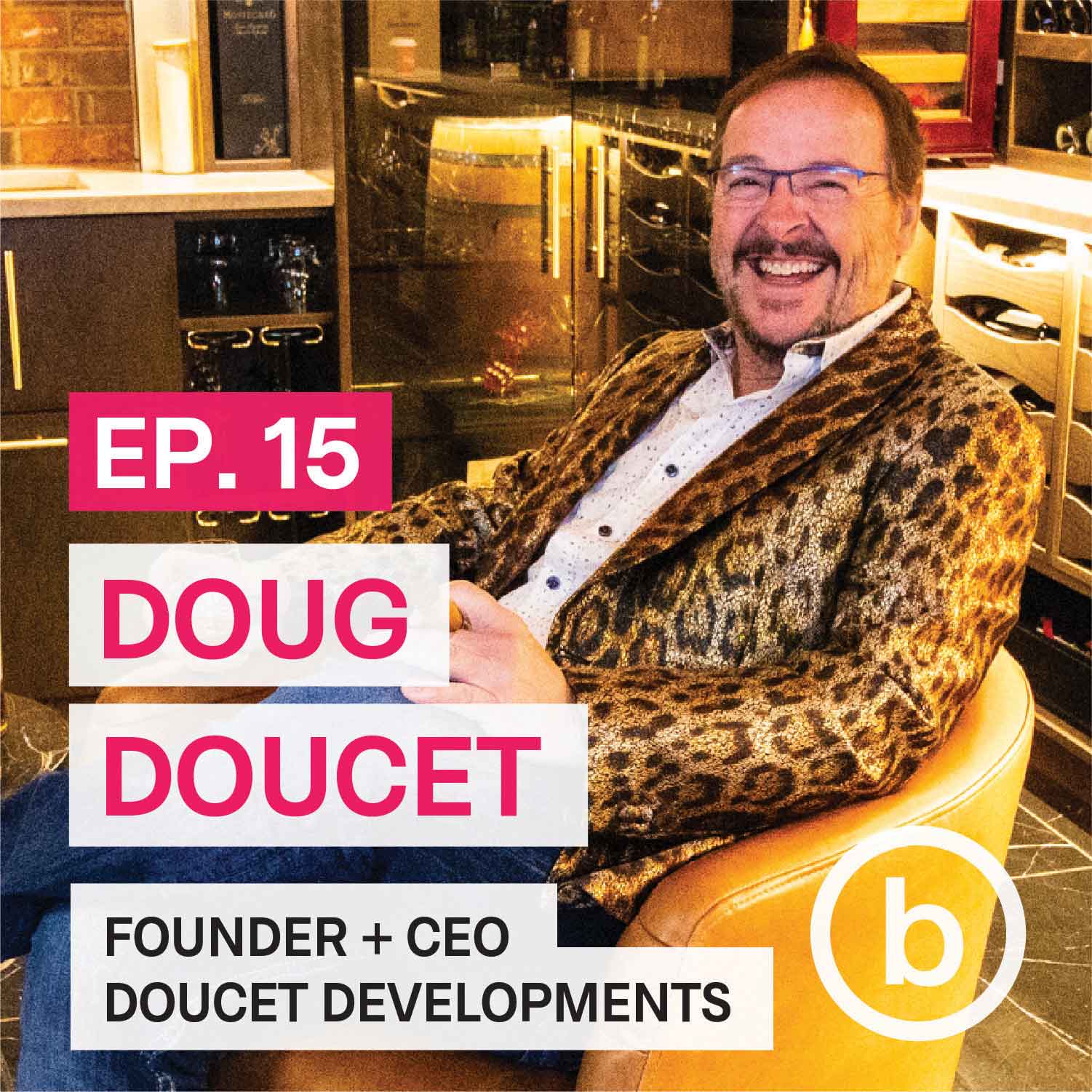
Doug Doucet, welcome to Design Makes Everything Better. , you are president and founder of Doucet Developments, which has a number of operating companies. You've got RCS Construction, which we'll probably spend most of our time talking about today. It also has Millwright Woodworking, which, of course, for anybody who's listening that doesn't know what that is, Millwright is a cabinetry and millworking company that builds all of the nice components that go into a particular project. And you've got Tier Two Properties, , which is a development and a real estate company. If I get the de- definition or general description for any of these wrong, just let me know. PM Co, which is your property management company, and Hero, which holds your hospitality and retail companies, and this is where there's a whole other network of businesses that fall from that, where you've got a hotel, which you built and you operate, and apartments, you have a mall, a golf course, a beautiful golf course, and then restaurants and more. So I guess we can start off by having, , a bit of understanding of how you relate to all those companies, what your role is in Doucet Developments, and, , yeah, maybe how they all, how they all connect.
[Doug]
Sure. Thanks, Vince. Thanks for having me, , wanting to listen to me for a few extra minutes today-
...on a beautiful, sunny day in Halifax.
[Vince]
Yeah. [laughing]
[Doug]
, you know, I'm the founder and CEO of Doucet Developments, but the core, the core business in the beginning, thirty years ago, it'll be thirty years in September, is RCS Construction, and that's kind of where it started. You kind of... You know, I was a- I'm an entrepreneur, and I knew I would be in business. So when the time came to start the business, I had been in construction working in Ontario, and so you come home, and you start a construction company. Today, the construction company is far more. It's the least involved piece of the business for me now.
I've got a great leadership team. They run the business. They have a hundred and sixty-five employees, and, , this year we'll top well above two hundred million in construction, and they manage it well. And, , I now focus on being what I am, and what I do best, to your question, is a visionary. , I see things differently than a lot of other people, , and I'm able to visualize something, a development, a property, an opportunity, a deal, , and then give it to our team, who's so vertically integrated, can just run with it. So at one point, I would jump into a deal and have to be involved all the way through. Now, I jump into a deal, and I move on after the vision is shared, if that makes sense.
[Vince]
. Yeah. I- 'cause it's funny that you describe yourself as a visionary and, , as your core competency. 'Cause I think most people who know you, myself included, would just see you as a super strong relationship builder.
[Doug]
Yes.
[Vince]
, maybe they go hand in hand, but y- you would say that your superpower is being able to find the unseen way of operating something or, , an opportunity that people don't otherwise see. Is that, is that the core that brought you through RCS and to all the other things? Is that fundamentally the thing?
[Doug]
I think the visionary piece has been unleashed as I've gotten away from the construction. I think in the beginning, it was just starting a company, and the vision really stopped there. I think I learned along the way that I had much more vision, and my core attribute is relationship building.
There's no question. , and I think now I use the vision piece to get into a development or get involved with a development, and then, you know, the relationship thing is just getting deals done. , you know, we've always, always considered ourself a relationship company as our unique ability, our unique... , something that allows us to, to compete differently.
So, , I think, who was it? Robert Zed held a little seminar one day, and he told me about the WITT factor. He came up with the WITT factor, and this is what you need to know for business. WITT is W-I-T-T, and it's you need to find out what's important to them. Once you know what's important to them, then it changes everything. It changes the game. It's almost an unfair advantage. So I think the, the WITT factor is something that's helped me build relationships, because if I go golfing with a new client and, you know, I spend four hours getting to know them and getting to know what's important to them, which is the beginning of a strong relationship.
[Vince]
. There, there seems to be a, like, a disconnect for me in understanding how a lot... Just to kind of maybe dive into specifically RCS, which is one of the companies that we just described. ,
mo- a lot of the projects that are won are won through an RFP process, right? And, , the RFP process has a bit of a divide between, , the contracting company, yourself, and the client. You, you can't really necessarily understand what it is that they're looking for specifically. You don't have
a, a, a deeper relationship. You can't discuss the RFP in an open table discussion. It's everything is usually question and response by email. The... How does that RFP process then work relative to relationship building, which might be more of an entrepreneur to entrepreneur discussion?
[Doug]
It's, it's, it's different for so many different clients, and, you know, we try to eliminate the RFP process. We try to get our way and use the relationship-
... to have our clients realize they don't need to go to the competitive RFP process, and that's, you know, typically, it's- it goes in waves, you know? , 2008, probably sixty to seventy percent of our work was negotiated, so the RFP process isn't in place. 2009 comes in, global recession, eighty percent of our business becomes RFP-driven because CEOs are out saying, "Get a better price. Add more people."
"We want more bidders." And now we've worked our way back to the point where, after COVID, we're probably back to fifty percent negotiated/no RFP required, and, you know, that comes from a relationship. It comes from trust.
The only, the only time you don't add additional bidders to an RFP is when you trust the person you're dealing with. So I'm very, very proud. I've got right on my wall at the office, it's... You've probably heard it before, but Warren Buffett says, "You know, it takes twenty years to build a s- a strong relationship and five minutes to screw it up."
[Vince]
Yeah.
[Doug]
So that, that little thing is on my shoulder all the time, reminding me, like, "Don't mess this up. You got a good thing." I mean, sometimes we screw up-... and then we own it.
[Vince]
Yeah, yeah.
[Doug]
You know, you look your client in the eye and you say, "How are we gonna fix this, and what can we do?" And you do whatever you can to turn it around.
[Vince]
Yeah. Yeah. Does- , how do you communicate that through the, the team? Like, , the ability to respond to
mistakes and challenges.
[Doug]
You know what I always say, one of my favorite sayings is, "Good people hire good people, and assholes hire assholes."
So I- we've got a bunch of good people, and it just, it just resonates. It becomes a team of good people. And as crazy as that sounds, if... Everything is driven from leadership, and me as a leader, people see that I don't... You know, I, I do everything I say. I get back to every single person about every single request they talk to me about, and that's a lot of work to do that. But I believe, you know, your staff are everything. They make you who you are as a company. They make your brand. , so if they... You have to lead by example. You have to do- you know, you have to be the guy that empties the garbage can when nobody's looking or the guy that picks up trash when nobody's around to see you do it.
You know, that, that is what I see leaders, when I see people do those things, or a guy that empties the dishwasher in the, in the lunchroom, right? And I say, "the guy," because it's not usually the guy, and he should be the guy, [chuckles] so.
[Vince]
Right.
[Doug]
But, you know, things like that, little small things like that is what identifies leaders in my opinion.
You know, they do things when they don't need to do things, extra things.
[Vince]
Right. So they would know that they've got a mistake that they have to deal with, and you would be behind them, and they know that you would be behind them to make the decision that they need to make
in order to correct the problem. What would be a process involved if somebody has an issue that is potentially a big problem? Like, does it go- does it end up at your desk at any point, or is it now controlled internally enough that you wouldn't necessarily even know about it?
[Doug]
No, it, it doesn't end up at my desk unless it's a very serious issue that the owner of that c- you know, the, the p- potential development or project-
... didn't get satisfaction. But the reality is, my leadership team does get that satisfaction, and, you know, they, they take the bullets.
And, you know, there was a time 10 years ago where the bullets were coming at me constantly, and I couldn't manage it. Like, like, my most... My, my worst day is an unhappy client.
[Vince]
Yeah.
[Doug]
That just kills me. It takes- And I have to roll up my sleeves and make it better before I can feel good again. And at one point, you know, we talked as a leadership group, and we're like: "Guys, somebody's gotta take these bullets. So if you guys are taking the bullets, then I can be positive, I can be the visionary, I can be the r- you know, the relationship guy." I can do so many things.
Very rarely that I go to a conference or go to Toronto or go to wherever, and I don't come back with an idea or another development or another opportunity.
So but if I'm putting out fires, and it's ruining-
[Vince]
Yeah
[Doug]
... my day or my week after week, then you're not getting the best value. And Andrew Doucet, who's, who's a partner, and, , , he runs kind of operations, , he has been super at taking the bullets. Like, he-
... his unique ability is solving problems. He can get in, roll... Like, unfortunately, today's, today's new generations-
... they don't like to deal with problems.
[Vince]
No.
[Doug]
They like to avoid them, and they like to, you know, hide behind them. They hide behind their keyboards and hide... Whereas once you deal with that problem and you get it behind you, it just lifts everybody up.
[Vince]
Yeah.
[Doug]
So we go at the problems, we attack the problems.
[Vince]
Yeah.
[Doug]
And Andrew takes the bullets, and I don't see bullets very often anymore, so I'm very fortunate, which has allowed me to do all these other wonderful things-
[Vince]
Yeah, yeah
[Doug]
... and focused on new opportunities.
[Vince]
Before Andrew stepped in, how did you manage that, that stress level all the time? Like, if you, if-
[Doug]
I had to fix it.
[Vince]
Yeah, but that, that's- w- okay. Were you-
[Doug]
I didn't manage it well. [chuckles]
[Vince]
Were you up at night? Were you... Did you not sleep?
[Doug]
No. [chuckles]
[Vince]
Like, that sounds extraordinarily stressful.
[Doug]
No, I, I have to be honest, there's only been a handful of times in my life that I've lost sleep to work. , I took a Dale Carnegie course when I was 28, the year I started the business, and to be quite honest with you, I'm like: "Shit, I could be actually teaching this. Maybe I should be teaching Dale Carnegie- [laughing]
... "because it was really easy. Everything came real natural. But one of the things, you know, that they said every night, "Remember when you go home tonight, you put the jacket, the business jacket, on the, on the door- doorknob, and you pick it back up in the morning." And that resonated with me to say, "Yeah, why do I don't..." You know, I had partners who lost sleep. I had- I know of all kinds of people who lose sleep to stressful situations in business, and to me, it's like: Hey, I just put the, the jacket of problems on the coat rack, and you pick it up tomorrow morning, and it'll be there. It'll be waiting. All the problems will be there. [chuckles] They won't go anywhere.
[Vince]
Wow, that-
[Doug]
And you... I-
[Vince]
I think that's actually your superpower.
I, I think if there's ever one like that, that, that is really... I, I really personally struggle with that a lot because you... I, I am like you, I think, in some regards when it comes to really taking it deeply when you have a client that's upset. 'Cause you've got a lot of people that are working, that are, you know, being taken care of by your company, right? And if you feel that there's a client that is, you know, taking that five minutes to break down what you took 20 years to build, like, it, it can be stressful, right? So, you, you... Are you saying that you learned that from someone else, or did you just naturally have that ability?
[Doug]
Yeah.
[Vince]
Like, did- where did you- where did that come from?
[Doug]
I think that Dale Carnegie course just opened my eyes to say, "Yeah, that makes sense." And I think, I obx- obviously, it's a gift not to lose sleep-
[Vince]
Yeah
[Doug]
... over stressful situations, and we've had our share of stre- you know, , you know, we built... We lost a million dollars building the building across the street, the farmers market, and it was the most stressful time of... But the- what you did to make it better was make things better. You, "Okay, we gotta go out and find more projects, and we gotta make more profits so that we can, you know, we don't lose that opportunity or, you know, the lost income opportunity." So I think you just create, ... I love cliches, and my favorite is, the harder you work, the luckier you get. So you gotta work a little harder when things go south.
And that's that simple.
[Vince]
, .
[Doug]
I'm a very simplistic leader. [chuckles]
There's nothing technically about me. [laughing]
[Vince]
Clear. Clear. [laughing]
[Doug]
Clear leader. [laughing]
[Vince]
[laughing] , so when, when you would come home, ... Let's just, I'm assuming that it's still the case, so you come home, you don't have that, the stress from the work that you carry through at home. Does that lend itself to a decent work-life balance? 'Cause my-... m- if outside looking at you, I see somebody who has a ton of different businesses and responsibilities, and you grew a construction company, which is not an easy thing to do. Construction companies are extraordinarily complex.
[Doug]
Yeah.
[Vince]
So to be able to balance that, come home, hang your jacket, and be present with the family, it just seems like a- it seems enormously difficult to me to do. Did you-
[Doug]
Well, I've lost a couple of wives going through it, so I wasn't very good at it either, apparently. [laughing]
But I've got a great relationship now with, , Lisa, the lady I'm with, and, , you know, we- I think we figure it out, and at the end of the day, I, , it could be just good luck. You know-
[Vince]
Right
[Doug]
... I was lucky. Maybe I was lucky with that gene.
[Vince]
Yeah.
[Doug]
, but I don't- I literally can... I can be, I can be in a very heated argument with a subtrade.
[Vince]
Yeah.
[Doug]
You know, I, I don't get in those anymore, but 10 years ago, it'd be nothing for me to be in a battle with a subtrade who didn't show up on a project for the third time in a row, and I'd be blasting- And I can literally, h- I didn't even know, but my partner would say, "Doug, you got everybody walking on eggshells. You're in there, you're cursing and swearing and hollering." I said, "Some of these guys need to be hollered at." They just- some need to be told how wonderful they are, some need to be hollered at, and some just do the job. We like those ones.
[Vince]
Yeah, yeah, yeah.
[Doug]
We like the subs that just do the job.
[Vince]
Exactly. Yeah.
[Doug]
But I'd get in these battles, and it was almost a bit of a game, and then I could hang the phone up, and I'd come out of the office singing, and the office staff would be like, "They don't know what's going to come out of that door." And I'm like, "It's done. Okay, that's done. We dealt with that." I feel better because it's dealt with, and I can move right into another mood-
[Vince]
Yeah
[Doug]
... which I think is maybe a gift. [chuckles]
[Vince]
Yeah. Yeah, I think it is. I think it is. Well, there's, there's another, another side there in terms of, like, how you've des- described
walking on site or people walking on eggshells because they're worried about maybe how you might say something to them or after a conversation that you had with a subtrade that was difficult, like, that intensity. , I'm just... I'm super curious 'cause I, I literally only know you as the guy, like-
... I see right now in front of me-
... who is this super smiley, always laughing, happy guy.
[Doug]
It's not always that way. [chuckles]
[Vince]
Yeah, so I'm just, I'm just trying to pick that apart because I, I am- I... Yeah. What, what, what worries you then, outside of maybe making a client- keeping a client happy? Is there, is there what... Okay, maybe, maybe put it this way: What's the thing on the top of your mind right now as a, as a problem you're trying to solve?
[Doug]
On top of my mind as a problem I'm trying to solve? , probably my biggest issue right now is finding a golf swing that works, that I can actually score.
It's probably my biggest concern. [laughing]
[Vince]
So I've seen a lot of people really angry about that, so I could understand that.
[Doug]
I, you know, I don't think there's a real problem. I mean, affordable housing's been something that, you know, I identified probably 10 years ago as being an issue, and I, I literally have a file set up on affordable housing. I've been collecting data. I went to China to look what affordable housing could look like, and well before we had the issue in the country, you know, 10 years ago, we weren't talking about it. But I saw it coming, and I've been trying to figure out how to build an affordable home and what is truly the definition of affordability. I mean, if we could find a way to build a 100-unit apartment building that made sense, we could build one for every town in Nova Scotia right now-
... from Antigonish to Sydney to, you know, New Glasgow. But, you know, it's a real simple business. It's the cost of construction versus the cost of rent you can pull in, and the cost of construction in these areas is more-
... and the cost of rent is less, and the margins are very tight. So we're all trying to think about how we can build affordable housing, and it's really, really hard to do.
[Vince]
It is. It is.
[Doug]
So that's been one that's kinda still driving me nuts, and I think we're getting to a point where, you know, probably 10 years ago, modular construction was a 30% increase.
And in the East Coast, we don't have the luxury of paying 30% more just because we want to be something different. , I think now it's closer to 15 or 20% because of the, the construction costs, labor, supplies. So I think modular is becoming a better solution, controlled environment. The problem with modular, it's not... You're not really manufacturing. Like, manufacturing is so far ahead of how they do things and how they package things and all the technical and all the-
... robots and all the, you know, how to make something more efficient. We are still building a modular unit in a garage with a carpenter, an electrician, and a hammer, and there's still a drywaller, dry... modular. Like, we gotta get to a point where wood goes into a factory and comes out as a modular unit, then we'll truly be getting- And I thought I would see that in China. It was really interesting 'cause I, I'm just- I'm a little bit, , into modular. I just think it's gonna be the way of the future at some point. But when I went to China, I thought I would see this robot building a house, and it was the total opposite. There... We saw no- we went to the biggest millwork facility in China, and there, I think there were 600, about 600,000 square feet, and there was probably 1,000 employees, and they're still building it with a hammer.
[Vince]
Yeah, well, labor is so much cheaper, right?
[Doug]
Labor is $5 an hour, $3 an hour, so, so they're not encouraged, whereas in the US, that same labor to build that same thing is gonna be $60 an hour.
So we're, we're gonna see more robotics in America than we're gonna see in China for that simple reason.
And that was really interesting. That was eye-opening to me.
[Vince]
. Have you, , looked at all into Austria?
[Doug]
No, I haven't.
[Vince]
I, , lived in Austria for a little while. I had a small practice out there, and every single home that was being built in this area that I was living in, which is right near the Swiss Alps, was modular.
[Doug]
Really?
[Vince]
And this was back in 2000. Like, they-
[Doug]
Interesting
[Vince]
... it was just so much easier. , they were-
[Doug]
Yeah
[Vince]
... able to control the details off-site, and they would helicopter them in at times because they would be able to get them up the mountain, , perch them on some foundations quite easily. , the detailing behind that, it, it was just really quite remarkable. And really interestingly, the culture around building there is- it goes really, really deep. Like, there's a really deep history about it. , even so much so, like, they actually have woodworking-... detailing community competitions.
[Doug]
Oh, wow!
[Vince]
Have kids-
[Doug]
Pretty cool
[Vince]
... that are graduating from the school in the gymnasium, with their parents and grandparents in the stands watching them, and they have-
[Doug]
That's fantastic
[Vince]
... timing-
[Doug]
Love it
[Vince]
... to do the detailing, and they get awards for being the best in the detailing-
[Doug]
That's great
[Vince]
... and finishing it in the time. Get their name and picture in the newspaper. It's, it's a completely different world over there-
[Doug]
I love it
[Vince]
... when it comes to that.
[Doug]
Awesome.
[Vince]
So it's, it's worth checking out, for sure.
[Doug]
Yeah.
[Vince]
For sure.
[Doug]
For sure, I will.
[Vince]
So maybe back a little bit to something that you mentioned earlier, , losing, I think you said, a million bucks on the-
[Doug]
Yep
[Vince]
... seaport market.
[Doug]
2014, that was, like, probably $2 million today. [laughing]
[Vince]
Yeah, right. [laughing] What, what would you say were some of the things that caused that loss, and what did you learn from it as a company, and how did you respond to that?
[Doug]
Well, we learned, we learned a lot of things. I mean, the- it was the farmers' market, which is across the street here, and it was probably the most forward-thinking design at the time. I think it was going for platinum, , platinum designation for, at the time, I, I forget what they call it now, but-
[Vince]
LEED?
[Doug]
LEED platinum.
[Vince]
Yeah.
[Doug]
It was gonna be the first LEED platinum building in... , so that was a flag because, , , I'll just back up a little bit. It was five national GCs bidding on the job. There was no local bidder. , and we heard about it. We thought it was gonna be cutting-edge. It was our biggest project at the time, when we, when we looked at that in 2014. , we go found our way... We put together a package, , in the 11th hour. We got a bid in with five minutes to spare, and we got, we got added to the bid list, [lips smack] and we ended up winning the project. Little did we know, it would be the toughest project, to this day probably, I've ever had to be involved with.
[Vince]
Hmm.
[Doug]
, but the problem was they didn't have enough money for what they wanted to do.
[Vince]
Right.
[Doug]
, they had a $14 million budget for a $15 million building. They had no contingencies built in.
[Vince]
Something that might have been uncovered if you had the-
... chance to talk about it in the RFP process-
[Doug]
Exactly
[Vince]
... which is what I'm saying, right?
[Doug]
Exactly.
[Vince]
Yeah.
[Doug]
And it was- there was no involvement with us in the RFP process, but it was a really unique building, and I wanted to be attached to it, and I didn't-
[Vince]
Hmm
[Doug]
... feel like something this cool should not have a local presence.
[Vince]
Yeah.
[Doug]
So we bid the job. We went at it tight, and we won the job, and then it became a fight. Right from the beginning, , it was just a constant battle because there wasn't enough money to do things right. , things were getting cut from the drawings but then get it back- added back in, which meant more cost. , there was just a whole scenario of problems. It was probably a big bite for us. , we got unionized, or we got, we got certified from the union through the project because we were getting bigger, and, and it happened kind of... It's a long story. It's a whole another- we could do another podcast on that one.
[Vince]
Yeah.
[Doug]
But we ended up, you know, beating the certification, but that was six months of trial, and, you know, that was another bucket of money. Then we lost all kinds of money because we were just in a constant battle with the architect. , and it- but at the end of the day, I'm still proud of the building 'cause we-
[Vince]
Hmm
[Doug]
... you know, it was- we were probably punching above our weight, and I'll take that ownership. So did we learn a ton of stuff? Absolutely. Did it happen again? No.
[Vince]
Hmm.
[Doug]
And I'm a believer that, you know, once things happen twice, you shouldn't be in business, when you make mistakes twice, so the same mistake anyways.
[Vince]
Yeah.
[Doug]
, so yeah, so no. We learned that we were in a... The big- one of the biggest factors, we were a relationship company, and I lost one of my senior PMs at that time, and I remember him really struggling. We had to fight. We had to fight with the architect. We had to fight with the design team.
We had to fight to say, "This is not included, and we need to be paid," and we weren't good fighters, so because we're a relationship company.
[Vince]
Interesting.
[Doug]
So when one of my PMs finally quit, I ended up having to come in and run the project, had brought in another senior guy to help me, and, you know, we worked with the port, and we got through it. They were very good. I remember working with Paul and, and the port people, and we kind of got through it, but it didn't help our situation. But when I addressed my project manager, said, "Why are you leaving?" He said, "Doug, you've, you've taught me for five years how to treat people good, how to... You know, it's okay to lose to a client. It's okay to step back and, and give in sometimes, and you've taught me to be a relationship guy. Now you want me to fight, and I just... It's not-
[Vince]
Can't do it.
[Doug]
You can't do both."
[Vince]
Yeah.
[Doug]
And so we weren't good fighters, and that taught us that probably we shouldn't be in that environment. If it's gonna be that type of a project with that type of leadership, if it's not- if the client is not driven by relationships, then it's probably not a project for us, which is hence why we don't do any public tender work. Like, there's zero relationship in public tender work.
[Vince]
Well, yeah, this is... Yeah, this is what I'm getting at, yeah-
[Doug]
Yeah
[Vince]
... earlier. Yeah, yeah, exactly.
[Doug]
Literally, you can be the biggest asshole in the world, do a shitty job, and they hire you on the next job.
[Vince]
Yeah.
[Doug]
And-
[Vince]
'Cause you've got the credentials by quantity. You've done exactly the same kind of project, even though it's shit, and nobody likes it, you've met a certain criteria, and-
[Doug]
And you get in.
[Vince]
Yeah.
[Doug]
And so we're not good in that space, so we only ever look at a public tender when we need work, and that doesn't happen very often, thank God, so.
[Vince]
Yeah. Well, good for you guys. Then, , w- we're the same. We, we really try to stay away from a lot of the public RFPs for the exact same reason. , I used to work for... A long, long time ago, my dad was a, a cabinetmaker, so he had a construction company. So I grew up on a construction site, and I remember the, the process of winning an RFP
was to look for the gaps in the drawings-
... right? Right, like, it's just... 'Cause it's a natural thing because you wanna get into a space where the price is lowest, right? So you can win the job. And, , where, where is the, , the-... I, I guess maybe it's- is there an, is there an ethical line in there, or is it, is it just
unethical? Is that, is that appropriate? Is that just the nature of business? Is that- how, how would you-
[Doug]
I think it's personally unethical to me-
[Vince]
Yeah.
[Doug]
And we don't do it-
... , you know, because we're trying to build relationships.
[Vince]
Yeah.
[Doug]
You get caught doing that-
[Vince]
Yeah
[Doug]
... you ruin a relationship.
[Vince]
Yeah.
[Doug]
You know, five minutes, it's gone because you did something unethical.
[Vince]
Yeah.
[Doug]
, I guess everybody's opinion might be different to that, if you can find gaps in drawings. I mean, I know subtrades that look for gaps and price jobs because they know they're gonna make a whack of change-
[Vince]
Yeah
[Doug]
... money on change orders. We don't make, make- as a general contractor, it's a myth that we make more money with changes. Changes now are only 5% profit, and all we do is mark up subtrade or supplier invoices to 5%.
The overhead that comes with a change order through our office is way more than 5%. So it's a total myth that, "Oh, we make a bunch of money off of change orders." Subtrades make money off change orders-
[Vince]
Yeah
[Doug]
... because they're gouging, they're charging more for labor. It's our job to break down a change order-
[Vince]
Yeah
[Doug]
... to make sure that's not happening, but when we start to actually break down, we're now losing money on the change order because the, the, the owner has beat us down so low on changes-
[Vince]
Yeah
[Doug]
... that really it's everybody else making the money. So we love a job where, where we get in and get out and have no change orders.
[Vince]
Yeah, of course.
[Doug]
It's the way we make money.
[Vince]
Oh, yeah.
[Doug]
You know?
[Vince]
100%, 100%.
[Doug]
And the other thing I would say, to your point, I believe for the last 20 years, as developers and owners have beaten the crap out of the, all the design firms and the architect firms to get the lowest costs on design, which creates change orders-
[Vince]
Yeah
[Doug]
... or creates over-design.
[Vince]
Yeah.
[Doug]
So if you tell an engineer he's not getting paid 10 grand to design your steel, he's only getting paid five, he just designs it with big, fat steel because it's easy, and he has to make money.
[Vince]
Yeah.
[Doug]
And now you just paid through the nose.
And/or we beat the architect down so bad there's not enough money to make good drawings, and it's just big, gaping holes that cause change orders.
[Vince]
Yeah, yeah.
[Doug]
So pay your consultants, get good drawings.
[Vince]
Yeah.
[Doug]
And I, I'm not against RFP-
[Vince]
Yeah
[Doug]
... but do it right.
[Vince]
Yeah.
[Doug]
Get great drawings, make sure the holes are out of them, and have... The problem is when it comes to construction, there's no time left.
[Vince]
Yeah.
[Doug]
All the time's been wasted-
[Vince]
Yeah
[Doug]
... in the development process-
[Vince]
Yeah, that happens a lot
[Doug]
... and we just throw it down the contractor's throat, and that's gonna be an issue.
[Vince]
And 100%, and that's, that's why the, the partnership from the beginning, just to come again-
[Doug]
Yeah
[Vince]
... back to that, is so much more efficient. It's healthier, , and it- just at the end, the, the project is, it's, it's got a knowledge base that starts from the day the project was first designed on everybody on the team. Like, it's just- it's hard to imagine any kind of an organization is gonna do better if the leaders are fragmented across the length of the project versus starting in the beginning of it-
[Doug]
Yep
[Vince]
... together, right? So-
[Doug]
Yeah, I, I would say before COVID, we were back up to 30 or 35% negotiated work, and I would say after COVID, we've jumped to 60 because now owners are not looking for the cheapest price, they're looking for who can get it done-
[Vince]
Yeah
[Doug]
... because of the labor shortages and the material-
... and, you know, all the, all the materials and tariffs and-
... you know, rooftop units that aren't available for 18 months. And so now they're going to partner with general contractors that are proactive and will make sure that all the parts and pieces come on time and on schedule.
[Vince]
Yeah.
[Doug]
Budget's not as important anymore, which is great. You know, it's good for us, I think.
[Vince]
Yeah, that, absolutely. What would you say is maybe one of the more misunderstood, , beliefs of the construction industry or, or contractors? Like, what, what do you think people-
[Doug]
You know what?
[Vince]
... misunderstand?
[Doug]
It's funny, that pops into my mind is that, you know, that "construction guys", and now it's, you know, we've got... I think in our office we actually have 55% female in our office. , , we have lots of great immigrants working with us.
We have, you know, all kinds of incredible people that make the team, and people would associate construction guys-
... as rough and tough.
[Vince]
Yeah.
[Doug]
There are- I've worked in every aspect of the construction business, from labor, to carpenter, to project manager, to owner, and construction people are some of the nicest people in the world. They'd give you the shirt off your back. They show up. They do what's asked of them. , they come in every day, and I love our construction crew, and I've met so many great construction people. So I think there's probably a bit of a perception that we're rough, and gruff, and tough, and it's not. We got some really, really kind people, and we've always got some kind of charity event that, that our team is stepping up to volunteer for.
[Vince]
Yeah.
[Doug]
, just, that's maybe a misconception of the construction industry, I would say.
[Vince]
Yeah, yeah, I didn't think about it that way, but I think 100% you're right. Like, I just... I've always- one of my favorite things in, in construction or in what we do is showing up on site. It's the actual process of making things, and building, and, and just being around that, that tactile nature. 'Cause we can spend so much time doing work on drawings that just kind of get lost into the ether of, "Hopefully this will be built someday," and sometimes they don't happen, right? But you're always building things. You're always... Y- you know, the, the team at RCS is always making stuff. It's, it's funny-
[Doug]
We had-
[Vince]
really amazing
[Doug]
... we had a- it brings me to a point the other day, we had a sod turning for a new nur- a new long-term care facility we're building in Fall River, and, you know, we're all there, you know, with the politicians, and we're getting our pictures with the gold shovels, and, you know, it's all wonderful and dandy, and I'm... All these men are working, and, and women, there were several women on the site, are working down in the form work, down in the pits, and we're like, "Guys, why don't we get a picture with all them?"
[Vince]
Right.
[Doug]
Like, "Let's get them up here. They're building this building."
[Vince]
Yeah, yeah.
[Doug]
Like, we'd stand here like dignitaries and politicians-
... but we aren't putting that shovel in the ground. We know that.
[Vince]
With those fancy silver shovels-
... that have never moved dirt before. Yeah.
[Doug]
But they did. They came up, and all the form workers came up and got in the picture, and I'm like, "Wow!" And I know they really appreciated it. We took time to s- to chat with each and every one of them and, you know, offered them a coffee and say, "Hey, thanks for what you do, 'cause we're gonna have long-term care beds here because of you guys."
[Vince]
Yeah. Is it, is it with Northwood?
[Doug]
Yes.
[Vince]
Oh, yeah, we just had, , Charbel here just, , last week.
[Doug]
Great guy.
[Vince]
Yeah.
[Doug]
Great guy.
[Vince]
Amazing, amazing guy.
[Doug]
Oh, he did the podcast?
[Vince]
Yeah, yeah.
[Doug]
Excellent.
[Vince]
He did it last week, so yeah.
[Doug]
Brilliant guy, man. I, I love time for Charbel-
[Vince]
Yeah
[Doug]
... very brilliant guy.
[Vince]
, you said that you are involved in a lot of, , , charity-... work, , there's a philanthropic nature to RCS or Doucet Developments. Is-
[Doug]
Yeah, there's-
[Vince]
Could you describe that a little bit more, and what you're-
[Doug]
I mean, I coined a phrase probably when I was on the f- I was on the board of the IWK Foundation. So, , after I, I served on the hospital board, and then I went to the foundation board, and it was one of the first big kind of foundation boards that I've been involved with. So I learned a lot from Jennifer Gilivan, who's an amazing lady in leading that, , foundation. And, , I coined the phrase... She s- she said to me one day at, at a board meeting, she said, , "You know, how much should we be pushing people to give? Like, what's, what's the right number?" And I'm like, "You should push everybody till... Everybody should give till it hurts a little bit."
You know, we should all give till it hurts, and that's- so actually, our tournament, our, our 25th annual golf tournament-
[Vince]
That's good
[Doug]
... this year, that was the, the line was on our golf balls was, "Give till it hurts." And giving till it hurts, for some people, it's money; for some people, it's time.
For some people, the, the effort is different. You know, , my ex-wife, you know, she went to the soup kitchen every Saturday, and she said, "Oh, don't ever break our plans up to do anything on a weekend because I'm going to the soup kitchen," and that was her thing. And I'm... You know, I'm, I'm the first guy to step up when there's an event and, you know, donate money and do what you have to, get involved, sell sponsorships, help people, but everybody can do something.
, it doesn't cost to help people.
[Vince]
Yeah.
[Doug]
So I encourage it. , I have my own philanthropic lanes that I stay in, and then the staff get to do their own thing. They get behind a different charity every year or two. , this year we did Ronald McDonald House at our golf tournament. , but they're volunteering at different events around town. , we really encourage them to get involved, and if it means a day off or time off, I think actually our policy is you can take volunteer days for, to go help in, with organizational-
[Vince]
Oh, good for you guys
[Doug]
... charity stuff. So, so I think we just encourage it, and again, I think
whatever your leader is and does, if they live and die by it, then everybody else will live and die by it, too. So-
... you know, I think you're constantly... I don't look at myself as teaching people how to be good, but I think if you're good, then people just automatically learn it.
I don't know if that makes any sense, but- [chuckles]
[Vince]
Yeah, it does. It does. So you would say that, , part of your, your style of leadership, both as in the company that we've talked about, companies, and in the philanthropic efforts, how you approach your day is through example, not through, , any other form of leadership, or is there-
[Doug]
Yeah, it's definitely by example. I would lead by example in that department. I mean, the first real big thing for me, you know, that was a, a, a, a, a we, we had, ... Phil Otto had called me up, and there was, , , the Great Big Gig-
-and he had asked me would I check- step in and be the chair of the event for the next three years, and it was a big found... You know, at the time, they were raising 300 grand a year, and it was a big deal, and, you know, a room of 6 or 700 people, and I'm like, "Phil, I don't have the same business contacts as you. Like, I- the only way that I'll do it is if I can rebrand it the Great Big Dig, and then we'll focus on construction suppliers and subtrades, and, and it'll be something they can gravitate to, as opposed to the Great Big Gig, which-
[Vince]
Yeah
[Doug]
... is just another name-
[Vince]
Yeah, yeah
[Doug]
... and another spin, but something we could stand behind."
[Vince]
Interesting.
[Doug]
And I think I did that for three years, and in the last year, we raised 500K, and I think we've raised 4 million up to last year. It's been 13 years, and it's all construction industry driven, and it's a phenomenal night. You've probably been there.
[Vince]
Yeah, yeah. It's a great night.
[Doug]
You guys, you guys did the sign for it that's still being used-
[Vince]
Yes, that's right
[Doug]
... 14 years later. [laughing]
[Vince]
Is that right, it's still being used?
Yeah, that was, that was, , led by Glenn McMinn.
[Doug]
You got it.
[Vince]
He was our old partner in the office.
[Doug]
It was all the light theatrics, the coming... I think they had a lot of experience with lighting and stuff.
[Vince]
Yeah, yeah, yeah.
[Doug]
And, , that sign is still being used 14 years later. [laughing]
[Vince]
Oh, I didn't know that that was still used. That's great. Amazing.
[Doug]
It's always... We always have the big debate on who's gonna store it, 'cause the thing's massive, you know? [laughing]
[Vince]
Yeah. [laughing]
[Doug]
I think Lindsay has it there.
[Vince]
You can't have a little sign for the Great Big Dig.
[Doug]
Exactly.
[Vince]
Like, that just doesn't work, right? [laughing]
[Doug]
Exactly. Yeah. It's funny.
[Vince]
, how do you, , find
the people that you've got? Like, how... What, what's the- to have great people, not assholes, right, that you describe, that are taking your lead and your approach to things, like, how do you-
[Doug]
I mean-
[Vince]
... how do you get a hold of them?
[Doug]
We, we've, we've, we've got a great HR process, and we've got a great director of HR. , so I think it starts there, but I think there's also a gut feel for an entrepreneur or for-
I think, you know, you can have lunch with somebody and have a pretty good gut on them, that they're a good person or, you know, they're not just blowing smoke up your ass, or... Like, I can read through a resume pretty good, although with ChatGPT now, I can't tell who's read-
... or who's writing them-
[Vince]
Yeah. [laughing]
[Doug]
... who's writing them, 'cause-
[Vince]
True
[Doug]
... I had, I had a resume the other day, and I'm like... It came through LinkedIn, and I'm like, gave it to Andrew, and I'm like, "Andrew, this might be the best resume I've ever read." And he's like, ", it's ChatGPT." [laughing]
And then I didn't know whether, should I be excited that this guy is bright enough-
[Vince]
Right
[Doug]
... to use ChatGPT-
[Vince]
Yeah
[Doug]
... or he's too lazy to do his own? [chuckles]
[Vince]
Right, right. Yeah.
[Doug]
So I'm still twisted. [laughing]
[Vince]
Yeah, it's, it's a difficult problem to solve. I don't know.
[Doug]
I think good people hire good people, and once people h- , hear about your culture... Our culture's big. I mean, we don't miss a baby shower. We don't miss a barbecue. We have an international barbecue day, where everybody brings something from their home country. -
... there's something going on in our office every week to two weeks, , a celebration of sorts, and, you know, we've got a celebration room with a little bar, and, you know, we can have some-
... good food and go out on the patio and have a barbecue. And, , I think you have to genuinely, sincerely want to be that way for people to engage and want to be part of the team. And we have Blue Shirt Wednesday that our estimator, our head of estimating, came up with. You know, you gotta wear a blue shirt, blue shirt on Wednesdays, and they got blue shirt police going around the office. If you're not, you get wrote up, and, you know, you get thrown down in the gutter, and it's Blue Shirt Wednesday, and everybody wears blue. And I think that's a little thing, but it takes pride, right? People are actually-
[Vince]
Yeah
[Doug]
... thinking about putting a blue shirt on because they're proud of where they work, and that makes me proud.
[Vince]
It's an identity.
[Doug]
It's an identity.
[Vince]
It's an identity as a whole, right?
[Doug]
It's an identity, for sure.
[Vince]
I get that.
[Doug]
For sure.
[Vince]
I get that. , w- when it comes to understanding culture and, , how it's connected to the variety of different companies, is there a cultural difference between RCS and, say, Tier 2 or-... PM Co?
[Doug]
I would, no, I would say Doug's still the leader, although I have partners in each of the businesses, and they're all, you know, they're different in each business. And I, I still think people look to Doug as the visionary of the business as a whole. I would argue that I'm the visionary in every one of those businesses, and we have an integrator in every one of those businesses that, you know, takes it and runs with it. But they're believing and buying into Doug's vision of what something can be, and culture's a big part of that. Relationships is a huge part of that. And they buy in, and they know. You know, we have... Our core values is called ACT. It's the way you act at a Ducet Development company. It's accountability, communication, and teamwork. And although they are somewhat subjective, if you're not the most accountable person you know, and you don't communicate enough, and you're not a team player, you're not gonna be on our team.
And that's tough, and we've had to let people go 'cause they don't believe in our core values.
[Vince]
Yeah. Good. , you mentioned, , a couple times now, , words that come from a book called Traction?
[Doug]
Yes.
[Vince]
So you have integrator, integrator, , and visionary-
[Doug]
Yes
[Vince]
... the, as, as defined in this book as a way to organize
a company, , entrepreneurial organization system, right?
[Doug]
Yes.
[Vince]
EOS.
[Doug]
You got it.
[Vince]
Could you describe that a little bit? How, how did you come across it? , how has it been an influence for you in, in all of your companies?
[Doug]
Yeah, it's been the most significant influence in our company and our whole organization as a whole, including the people, because they believe in it, and we live it. , I was asked by a client in probably 10 years ago, Stephanie Bertozzi had reached out to me, and she said, "Doug, you need to read the book Traction. It's gonna change your life." And I'm like, "Stephanie, I don't read. I can't get to the bottom of the page, and my head is going in circles-
... wanting to solve all the world's problems. I can't do it." So she called me again in November and says, "Did you read the book?" And I said, "No, Stephanie, I didn't read the book, but I'm going on holidays. I promise I'll read the book." So I started reading the book, and I'm like, "I'm into it," the first paragraph. I, I read it in two and a half days. I just, I... This book is-
And what was exciting, the book was how to run your business, how to, you know, set process in place, make accountability for all the people in the business, and, you know. And when I'm reading the book, I'm saying, "We're doing 75% of this stuff already. We're doing it." But what it gave me was the 25%. We were stuck. We, we were doing $75 million in business for the last four years, and that never happened before. We always grew, and at the time, I didn't realize, we hear about the ceiling, hit the ceiling, or you hit the growth wall, or you hit the... We were stuck.
Our- the way we did business no longer worked for us to grow. So the book, although we were doing much of it, there was 25% we weren't doing. Once we adapted that 25% and filled in the gaps, created more process, all of a sudden, the business took off like crazy, and within three years, we were $100 million, and then it was $150, and this year it's gonna be $240 million. So, , you know, the bus- the business has gone wild, and w- we're actually at a point now where we're wondering if we're even outgrowing Traction because, you know... Or maybe we just have to adapt it, I think is what we'll end up doing. But it really is just, it's 20 tools. It's incredibly simple. , you hire-
... an implementer to come in and help you get on board. We just have a, a new local implementer here in town now, so I'm hoping... I, I, I have buy, I've bought three boxes of the books, and every time-
[Vince]
Wow
[Doug]
... I'm, I'm mentoring a young person or talking to people in business, I tell them about it, and if they get excited, I give them a book. So I've given away two and a half boxes of books, and-
[Vince]
Very cool
[Doug]
... I just, it's like cheating. I, I get so excited about it because it's like a system on how to run your business. And the idea of the system is, yes, based on people in the right seats, accountability, visionary, integrator. Integrators challenges the visionary because the visionary has too many ideas, and he's not focused, and he's all over the map. So the integrator takes it, and, "Hey, Doug, although you have 10 ideas, we're gonna just do this one for now."
[Vince]
Yeah, yeah.
[Doug]
"Leave it, you know, we're gonna make it happen, and we're gonna do it really well." And I'm okay with that because that's the integrator's job. So I think all the parts and pieces that come with it, all our meetings are held the same way. They're on, ... There's a, there's a software that we use. , you know, you don't have to call people out in meetings. The computer will call people out. There's nothing worse than being in a meeting with your leadership team, and people are calling each other out. Well, the computer will call you out because you didn't do something, and, you know, you're supposed to get back to the computer and say, "Hey, I..." If you don't do what you say you're gonna do, you have to come back in and say why and be prepared for the meeting.
[Vince]
Right.
[Doug]
So in the first couple of... Nobody wants to be called out, especially by one of your, your peers.
[Vince]
Your colleagues, yeah.
[Doug]
But when the computer does it, it's equally embarrassing for the person who didn't do their stuff, but then there's no animosity within the group. But at the end of the day, it's, you know, do people, do people... Are people in the right... A lot of people are really, really good people, but they may just be in the right seat. So when I- after reading Traction, I came back from Florida. We had to, we had to, , [lips smack] remove two people from the leadership team. We had to let seven people go, and we changed five people in their roles, and the company just went through the roof. There was this, you know... People don't realize one bad apple can destroy 10.
[Vince]
Yeah.
[Doug]
And so we tend to live longer. Like, like, as good people, you tend to hold on to people and hope they'll be better and hope they'll do better, and you hope, and we hope too much. I mean, the book basically says that, , ... the book says that, where was I going? Forget. Anyway.
[Vince]
Doesn't matter.
[Doug]
[chuckles] , you know, the, the, the, the book also does a study on... , there's a Harvard study which really, really resonates with me, and the average company in North America, 20% are underachievers, 60% are average. You know, they come to work every day, show up, do what they say they're gonna do, and 20% are overachievers. And it went on, the study went on to say the brain can't jump two spots. So the brain doesn't have the capacity. You can work on that underachiever, and at best, you can make them an average employee. And when I say average, I say average are your prime employees.
[Vince]
Yeah.
[Doug]
They're the employees that just come up every day, show up, do what they're asked. And then overachievers-... you don't mess with those guys. They aren't going any farther. They produce, they don't need process. It's the 60% where you gotta spend all your time, you gotta take the average people, work with them, and try to make them above average by giving them the skills, giving them the process, giving them... They want help. They wanna be better. Whereas if you start- s- this is what happens in big companies, they just make a process for the whole company. Well, the overachievers, once you start throwing process down their throat, they're leaving.
[Vince]
Yeah.
[Doug]
They don't need process.
[Vince]
Right.
[Doug]
They achieve, they have their own internal process. You know, a lot of times, that top 20% are people that are gonna eventually leave and become your competition 'cause they're good.
[Vince]
Yeah. Yeah.
[Doug]
So it's the 60% that make up your livelihood, and focus all your energy there.
[Vince]
That's interesting. Do all your leaders read it, or have they read it?
[Doug]
All my leaders definitely have read it. , we're-
... probably 10 years in now, so, , we'll be do- we'll, we'll get an implementer in once a year to come back and just kinda... An outside source to make sure we're doing everything we say we're doing. 'Cause, you know, three years ago, we had the guy come in from Montreal, and he's like, "You guys aren't living this," and he just grilled us for two days. And it was like, "Wow, we weren't living it." So, you know, you need a refresher, you need someone, a little coach there, that's kind of pushing you-
... making sure you're not falling off the rails, but-
[Vince]
Interesting
[Doug]
... we live and die by it. It's amazing.
[Vince]
Okay.
[Doug]
I feel like it's cheating. I don't even think I should be telling everybody, 'cause they're gonna start doing it [chuckles].
[Vince]
Well, it's really funny. I- it's been, [clears throat] it's been on my desk, and I haven't actually read it yet. And I keep hearing about it as, as such a critical component in terms of growing a business and, you know, m-
[Doug]
If you wanna grow your business, it's the way to go. But what it does, the whole idea is for a business owner to... The, the, the thought process is remove yourself from the business and let your team build the business-
[Vince]
Yeah
[Doug]
... and grow it. You just sit at a high level and watch it grow. And some of the, some of the implementers that I've, , that I've been to, I mean, they've all integrated this into their businesses, and, you know, they're, they're putting 20% of their time, or it used to be 120%. Used to be seven days a week. So for me, it, it can remove you from the day-to-day business, where you really can have a great life and just watch your business flourish. For me, it allowed me to go into all these other things.
[Vince]
Right.
[Doug]
So I wasn't at the stage in life where I wanted to just sit back and watch it. I wanted to continue growing. I'll probably continue growing stuff until I die, so-
[Vince]
Yeah
[Doug]
... but it gave me, over the last 10 years, you've seen all the other things we're kind of involved in. It's allowed us to grow that to a whole another level, , because I'm focused on that. I wouldn't spend two hours a week in RCS anymore, so-
[Vince]
Interesting
[Doug]
... you know, all my time is spent on the other stuff, which creates opportunities for RCS-
[Vince]
Yeah
[Doug]
... and all the other companies.
[Vince]
Yeah.
[Doug]
So.
[Vince]
Yeah, yeah. What, ... We have to be aware of time here. It's, , just after 3:00-
[Doug]
Okay
[Vince]
... so I wanna, I wanna wrap this up for you. , so a couple questions. What, what's your motivation to keep growing? Like, what, what gets you excited in the morning when you wake up?
[Doug]
Oh, my God, that's a great question. , you know, success is- success has been different through my whole life. I mean, , I... You know, I remember, I remember when, , I moved into my first apartment in Toronto, and I was a laborer on a construction site, and there were crazy... I'd come from a fairly good family in Sydney. You know, we, we weren't wealthy by any means, but I was well taken care of and kept up. And we go into this, the shittiest neighborhood in Toronto, and it was full of cockroaches.
And at that time, I didn't even want to stay that first night. I remember, you know, turning the lights on, and they ki- we used to play games when we were drinking. You could turn the lights off, and cockroaches would come out when the lights went off, and you turned them on, they'd scatter, but you'd see how many you could trap. [chuckles] But to the point, the success for me was I was getting out of that neighborhood. So I was gonna work 90 hours a week to get out of that neighborhood and find a better place, 'cause I didn't want my new baby or my wife to have to live in that condition, and I didn't want to. So that was success for me, was moving. I mean, there was another time I was driving by, I think it was a, a car dealership, and I was working... I had worked my way up. Now I was project managing construction sites in Toronto, and I remember seeing this Cadillac, this 1984 Cadillac Coupe DeVille, and I'm thinking, "I want that car." And so that drove me to work every weekend, overtime. I needed to get the money to put a deposit on that car before it got sold, and six weeks later, had enough money for a deposit. Put it... That was success for me. I think now success for me... You know, there's been all kinds of evolutions of success.
Today, other people's success is success for me. So when I see people getting their first house, or I see people getting married, or I see, in m- in our organization, or I see somebody getting a new car, there's nothing gets me more excited when I see somebody pulling with a new car. That's my success today, is watching other people be successful and, you know, get to do what I had the opportunity to do. But it's a, it's a moving target. Success is a moving target for me. My next success will be a house on the waterfront somewhere in St. Margaret's Bay. I was in Chester last night. It was awful nice in Chester, so. [laughing]
[Vince]
Yeah, right. [laughing]
[Doug]
But that'll be, you know, maybe the next thing. So that's kind of the way I look at success. I've never really thought of it otherwise.
[Vince]
. And where... If you look ahead, , five years from now for RCS, what, what does it look like if it's continuing to be successful?
[Doug]
Well, I've taken on two partners, so Chris and A- Chris and Andrew are partners now, and, and they're buying, you know, parts of the business. So there is a succession plan. I'll be there as long as they want me there. I mean, I'll... You know, I can be the visionary and sit in my chair, and, you know, I see people every day there. So I, I s- I do a lot of stuff outside the office. I always say it's better for them to get me out of the office, 'cause stuff happens when I'm out of the office. You know, opportunities arise. But I think in the next five years, we're gonna keep going wide open. I think our goal is to be at 300 million within five years. , you know, we wanna be one of the biggest contractors in Atlantic Canada that still is family-driven, cultural-driven, relationship-driven. I mean, you know, I- we are a family. There's no question, and there's always the fear... I mean, I have some of my original employees that say, "You know, it's not what it was, and it's not the same, and you're not the same." And I'll take time to explain to them what I am actually doing.
You know, we've literally built entire buildings that I don't even get in to see, because I'm just so busy with other stuff. So I technically don't stray too far unless there's a problem. If there's a problem, then I'll roll up my sleeves, and I'm gonna jump in and help the team.
[Vince]
Right. Yeah.
[Doug]
But they pretty much tackle it on their own now, so it's fantastic.
[Vince]
Wow. -... Can I ask you one more question?
[Doug]
Yeah, sure.
[Vince]
'Cause you said something that, that strikes me. So, , I've always debated between having a- thinking of a, a business as a group of people that are a family or as, ... I can't remember the name of the Netflix owner now, but describes it as a high-performance team, like a sports team. 'Cause a family has within it an embedded series of complications that you can't actually, you know, fire a family.
You can't- There's, there's a, there's an, there's an emotional bridge there that isn't necessarily healthy for everybody in the company. But with a high-performance team, you have a deep sense of belonging. You have a sense of people taking care of you. They have a sense of, , , of camaraderie, but there is an expectation of performance with a high-level sports team. W-
h- how do you define, then, as a family being, , the best model for you
or for RCS and all of its other... and your other companies?
[Doug]
So I would argue with that and say that we are a family sports team, so- [laughs]
[Vince]
Right. [laughs]
[Doug]
... I think you can have both.
[Vince]
Right.
[Doug]
I think you can have both.
[Vince]
Right.
[Doug]
I mean, who's... You know, I've got a buddy who I thought was brilliant, and I never thought of it. He- you know, he re- we were just having a g- a golf game a couple of months ago, and he said, like, "We're focused on hiring, , ex-junior hockey players, because they're driven, they, you know, they're-
... they're committed, they've got passion." It's natural. , but they're also f- there's a family component to a great team.
[Vince]
Yeah.
[Doug]
I mean, your- the guys on the bench are your family.
[Vince]
Yeah.
[Doug]
I don't care if it's football, hockey, like, the, if the best teams, they're family. So I'd argue that both can happen, and I think we're there.
[Vince]
Oh, that's interesting.
[Doug]
Yeah.
[Vince]
Yeah, very cool. , you're happy?
[Doug]
Yeah, very happy.
[Vince]
Good.
[Doug]
I'm always looking for the next, , opportunity, and always looking to... I just, I just love traveling, because you can get out and see all what other people get to do. Like, we're in such a tough spot in Atlantic Canada. We don't have the density, we don't have the money, we don't have the budgets to do exciting things. So it's so nice to get out to Vegas and, you know, where there's no budget, or Nashville, and you see... I- it's, it's terrible, 'cause when I go on trips now, the staff are like, "Oh, God, Doug's away for two weeks. What's coming back?" [laughs]
[Vince]
Hey, yeah. [laughs]
[Doug]
" 'Cause I got a list of things- I can show you now, there's probably seven files of hotel ideas, restaurant ideas-
[Vince]
Yeah, I bet. I bet
[Doug]
... you know, home ideas. So I think it feeds me.
[Vince]
Yeah.
[Doug]
I don't think I'm getting tired. I don't think I'll ever get tired. I think I'll change. What I do now, when I started the opportunity to get outside of RCS, it was to create a role where I could thrive. And construction, if I had to do it all over again, and my, my staff will hate me for this, but I don't think I would get in construction. It's too tough. You said it earlier on-
... it's a very, very tough business. So we've turned it from a tough situation into a family, relationship-driven company that's got a great culture. That's really tough to do. , but I, I'm a believer that the leadership in every area of the business is what creates the leadership below. So, , I think we have great leaders that are creating other great leaders. Future leaders are gonna come. I've already seen a number of people that are very young in our organization that are gonna be in big roles.
[Vince]
Right.
[Doug]
, and we're already recognizing that. So, you know, we have our little file of superstars that are coming up through the ranks that, you know, we aren't gonna have to go abroad to look for the next leaders. They're here.
[Vince]
Amazing.
[Doug]
They're learning some great skills, so.
[Vince]
Well, thanks so much for coming in-
[Doug]
[laughs] My pleasure
[Vince]
... to chat. I, I could, I could honestly-
... we'll have to continue some more conversation over some beers or something.
[Doug]
Absolutely. [gentle music]
[Outro]
Thanks for listening to the Design Makes Everything Better podcast by Breakhouse, a Canadian strategic design firm. A full transcript and show notes can be found at breakhouse.ca/podcast/1. Have feedback or ideas for the show? Drop us a line at
[email protected].